ClearVoice calls your overdue accounts in Arabic and English. It verifies who it's speaking to, hears the borrower out, takes a payment or sets up a plan, and hands over to a person the moment it should. Every word is recorded and scored.
A recorded voice reading a script at someone doesn't recover money — it gets hung up on. ClearVoice holds an actual conversation, and it knows what it is allowed to offer before it dials.
The agent confirms it is speaking to the right person and delivers the disclosures your policy requires, on every single call, before anything else happens.
Someone who has lost their job needs a different conversation from someone who forgot. The agent works out which it is dealing with and responds to that — it isn't following one branch for everybody.
Take a payment, set up an instalment plan, or agree a settlement — but only within the offers you've authorised. It cannot invent a discount.
Hardship, a dispute, or any mention of a lawyer, the police or a complaint, and the conversation goes to a human specialist. Not to a callback queue.
This is the whole difference between us and a voice-AI vendor with a collections demo.
Identity, preferred language, product, how late the account is, what is outstanding, the minimum due, and when they last paid.
Prior outcomes, prior promises, and whether those promises broke. A repeat breaker gets a different conversation from a first-time slip.
Eligibility for restructures, instalment plans, deferrals and settlements is resolved before the call, so nothing outside your policy can be offered.
Your daily payment file is ingested before any contact goes out. Anyone who has paid or kept a promise comes off the list first.
Do-not-contact, deceased, insolvency, legal hold, dispute hold. Permitted calling hours, public holidays and Ramadan are applied at the same point.
Where contact data is stale we skip trace before dialling, so the reachable population is as large as it can be before anyone picks up a phone.
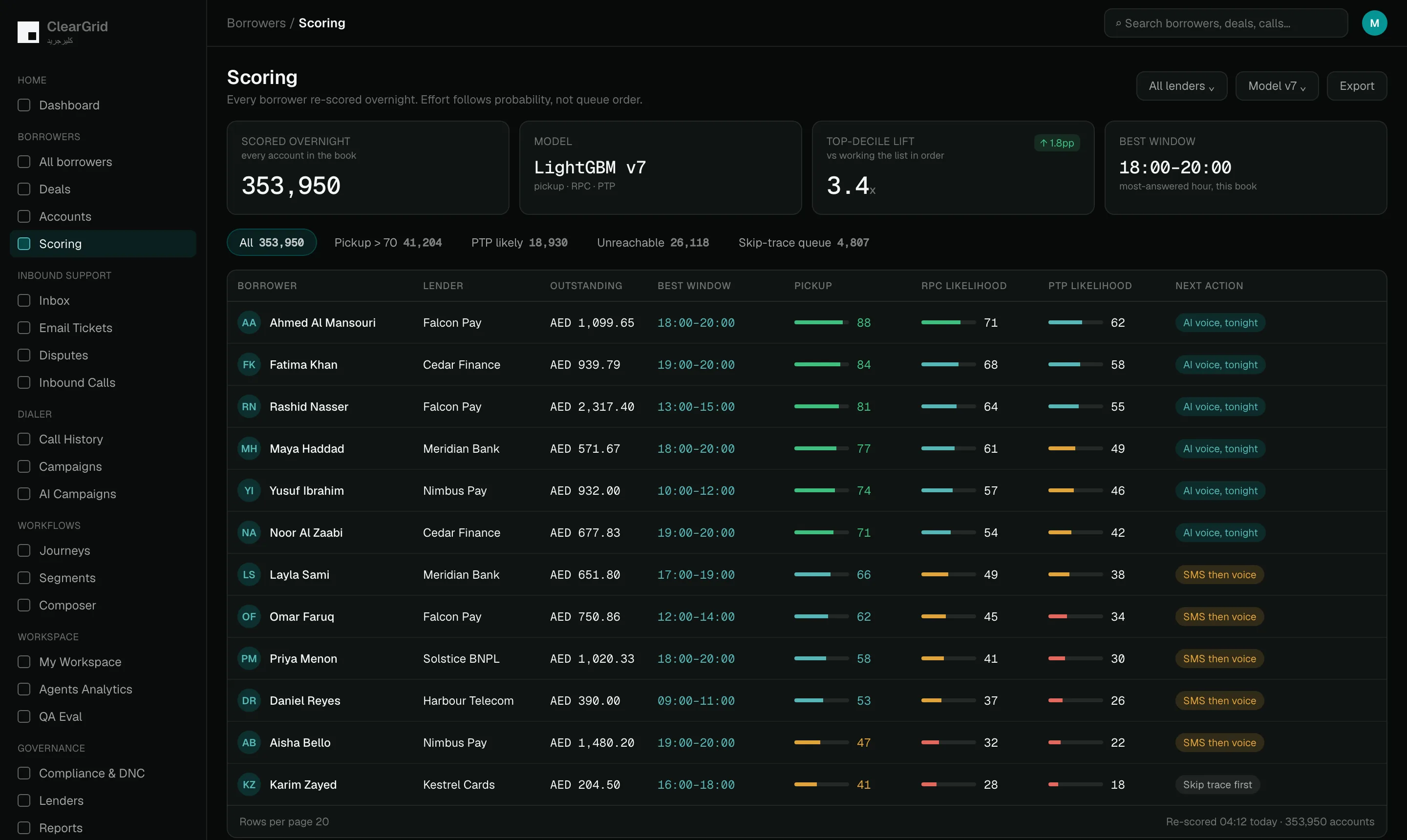
Every borrower in Command carries a pickup score — the probability that a call to them actually connects — refreshed daily. ClearVoice uses it to choose the channel and the calling window, so attempts aren't burned at the hour nobody answers. If voice is the wrong channel for someone, the journey sends a message or routes them to the portal instead.
How borrowers are scored →
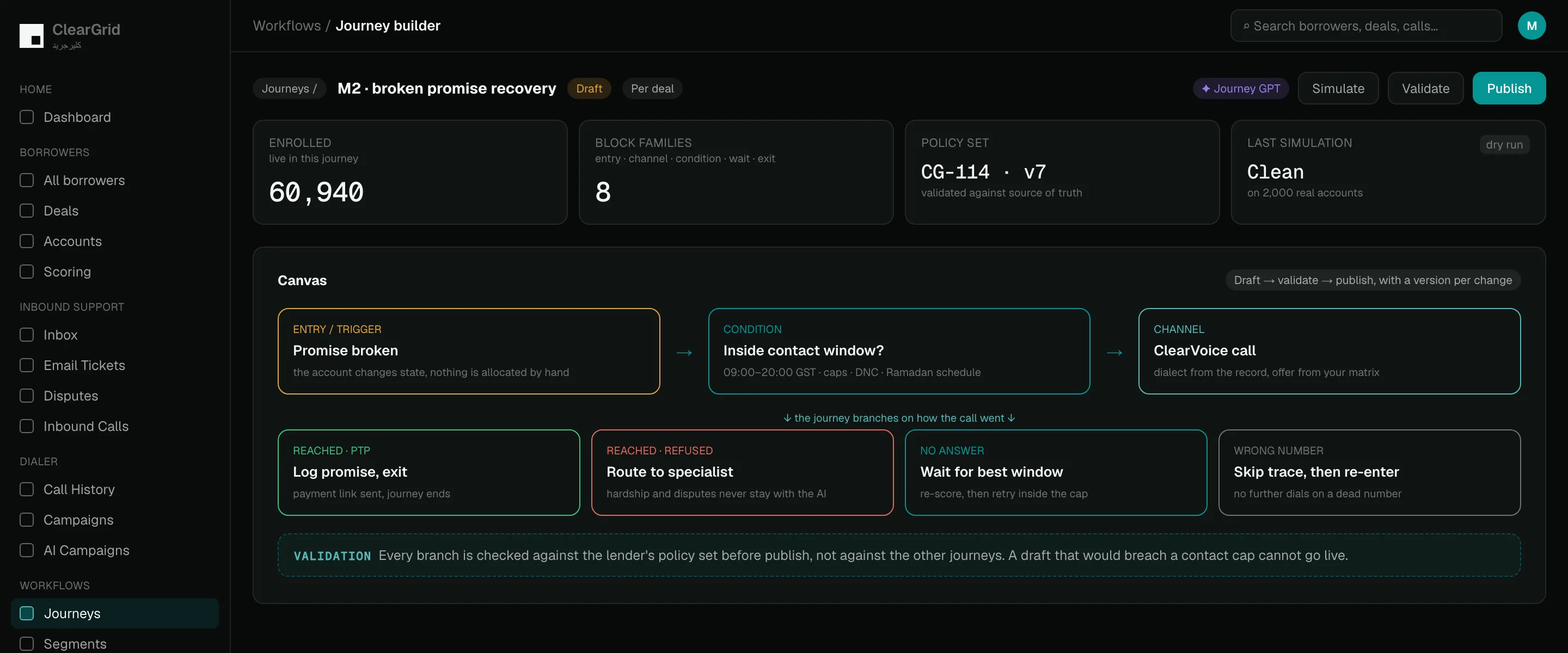
Calls are triggered by the account itself — a stage change, a broken promise, a segment your team defined — and the journey branches on how the call went. Nobody allocates a dialling list in the morning. Your managers design the flow by dragging it, and it dry-runs against real portfolio data before it reaches a borrower.
Inside journey orchestration →
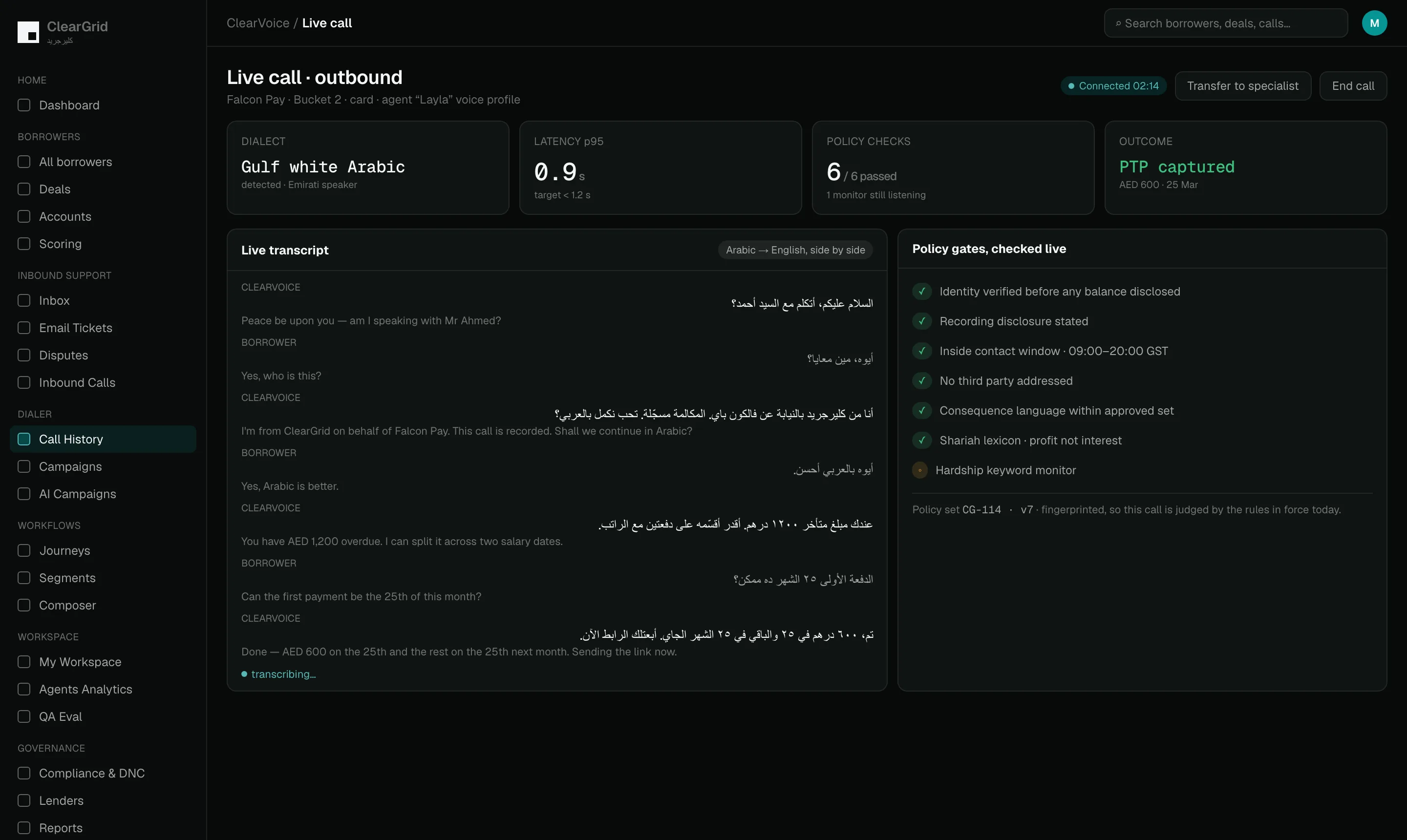
Five stages, in this order, on every call. The two that matter most are the ones either side of the conversation — what the AI knew before it dialled, and what happened to the recording afterwards.
Balance, days past due, every prior interaction, promises kept and broken, the plan already offered, and the language and dialect this borrower answers in.
Today’s payment file is ingested first, so nobody who has paid gets called. Suppressions, do-not-contact, contact windows, frequency caps, public holidays and the Ramadan schedule are applied before the list exists.
Identity verified before any balance is disclosed, recording disclosed, then a real exchange in the borrower’s own dialect — within the offers you authorised, and the consequence language you approved.
Every call is scored against the same rubric your own agents are scored against. Not a sample — every call. Compliance failures are counted separately and never averaged away.
Promise, payment, dispute, hardship flag or refusal, written to the borrower record with the recording and the transcript attached — and fed back into who gets called tomorrow.
Want to hear one? We will play a real Gulf Arabic call end to end, with the transcript and its QA scorecard beside it.
Not “Arabic support”, and not one flattened accent for a whole region. A borrower can tell within a sentence whether the register is right, and in a collections call the wrong register ends the conversation before it starts.
Emirati, Saudi Najdi and Hijazi, Kuwaiti, Bahraini, Qatari, Omani. Lebanese, Syrian, Jordanian, Palestinian. Egyptian. Each one delivered as that dialect rather than as a smoothed-out pan-Gulf approximation, because a borrower in Jeddah and a borrower in Kuwait City do not sound the same and can tell when a system pretends they do.
A large share of borrowers in the UAE and Saudi Arabia speak Hindi, Urdu, Tagalog or Malayalam at home. Those conversations happen in those languages rather than in an English fallback the borrower half-follows — which is the difference between a resolution and a complaint.
Some lenders and some stages call for MSA rather than dialect. It is a setting, not a limitation, and you choose which register ships per portfolio.
On a Shariah-compliant book the agent uses the right terms — profit and instalment rather than interest and late fee. That follows the bank, not the language.
Arabic verb agreement is driven by the gender field on the account. Guessing it from the spelling of a name is how vendors insult customers.
Absolute constructions are banned in Arabic no matter how late the account is. The agent never quotes a legal timeline and never speculates about a customer’s credit bureau status.
The UAE borrower population is not one accent. Persona and delivery are configurable rather than a single default voice.
Persona, voice, pace, push depth and vocabulary are set per lender. Two ClearGrid agents at two different banks are deliberately different. That is the design, not a side effect.
Send us ten of your own accounts. We will play back how each one would actually be handled, in the language and dialect that borrower speaks.
No other vendor will hold this conversation in Najdi. Send us ten of your own accounts and hear how they would actually be handled.
An AI caller that nobody audits is a liability. Every ClearVoice call goes through Unified QA on the same weighted model used to score human collectors — and a person approves every evaluation.
AI calls and human calls scored the same way, so “is the AI as good as my team?” is a question your own dashboard answers.
Every check on a scorecard carries a confidence level and a quote from the call it came from.
Your rules are wired into how calls are judged, and every version is fingerprinted — so you can always see which rules judged which call.
Response time is measured on every call and tracked to the 95th percentile. A borrower who hears a pause assumes the line dropped.
Legal threats are pulled for human review on every call, AI or human, and the escalation reaches you with a written reason and acknowledgment tracking.
We do not pool data across lenders, and no client’s data trains models used for another. Tactics are adapted to your borrower base, not lifted from someone else’s.
Every recording, transcript and outcome is available to you per call — by account, by agent, by time, by outcome. We do not gate your access to your own conversations, and you choose the review cadence.
Calling windows, frequency caps and do-not-contact are enforced by the platform across every channel, not left to whoever is on shift.
Every AI call is recorded against the account — type, status, outcome, disposition, duration, and who ended it. Your compliance team can filter, review and reconstruct any conversation, because the call log and the audit log are the same thing.
Inside Unified QA →
No telephony hardware, no second system to log into. Your agents call from the borrower's profile in Command and stay in context while they do it.
Voice, SMS and email land in one thread per borrower, whether the AI sent it or a person did. There is no separate AI history to reconcile.
Accounts flow in over SFTP or API and your portfolio structure, buckets and reference IDs are preserved. Nothing gets ripped out.
Hand us the portfolio and we work it on our own telephony with our own floor, paid on what we recover. Or licence the platform and run it yourself with your own team. Or split the book — which is what most banks actually do.
The standard deployment is hosted by us, with a physically separate database for each lender. For institutions that need every recording, transcript and record to stay inside their own cloud, we have deployment options that do exactly that.
AI-first with your people on exceptions. AI as overflow behind your priority accounts. Both channels working the book in parallel. Or a controlled split while you prove it out.
Where we operate the collections, the calls go out on our lines. You do not provision dialling capability or telephony infrastructure.
Thirty minutes. We'll run ClearVoice against a slice of your own book, in Arabic and English, and you can listen to what a borrower hears.