First-party collections (Command)

Your in-house collections team, powered by AI.

One place to see the portfolio, reach every borrower, and automate the strategy. Command replaces the spreadsheets, diallers, inboxes and reports a collections floor is normally stitched together from — with one system that holds the data, does the outreach, and shows the result.

Your problem

Too many tools. One broken workflow.

A sales CRM, a generic dialler and a spreadsheet of allocations. Your floor spends its day working around the tooling instead of working the book.

Problem 01

Five systems, five versions of the same borrower

Dialler, CRM, messaging, ticketing, BI. Five subscriptions, and nobody can say which record is right.

Problem 02

Built for sales, not collections

A sales CRM tracks deals. It has no concept of days past due, a promise to pay, or an instalment plan.

Problem 03

Numbers that never reconcile

Allocations, payments and promises live apart, so recovery reporting gets rebuilt by hand every month.

Problem 04

Everyone gets the same cadence

No scoring and no channel preference, so the borrower who would have paid gets the same treatment as the one who never will.

Problem 05

Compliance held in training

Consent, do-not-contact and contact limits live in an induction deck instead of in the system.

Problem 06

Nothing learns

Outcomes never feed back into strategy, so cost-to-collect only climbs.

The Command solution

Command replaces the stack, not one tool inside it.

One record per borrower, one place the strategy is defined, and one set of numbers everything reports against — with the conduct rules enforced by the platform rather than remembered by an agent.

Recognise your own stack in that list? Bring one portfolio slice and we will show you what consolidating it looks like on your numbers.

What Command is

One platform. Complete collections control.

One workspace

Every borrower, account and instalment in one record, with the full history attached.

Every channel

Voice, SMS and email in a single thread. Your agents and the AI on the same rails.

Strategy that runs itself

Define the treatment once; the platform executes it for every borrower, every time.

Compliance by design

Approved templates, recorded calls, enforced do-not-contact, and a full audit trail.

Modular by design — start with the piece you need, add the rest when you are ready.

Why a CRM cannot do this

A sales CRM tracks intent. Collections tracks obligation.

The difference is not features, it is what the system believes an account is. A CRM models a deal moving towards a close. Collections models a debt that ages, rolls, breaks its promises and carries legal and conduct obligations the whole way.

A sales CRM / a generic dialler
  • A stage you drag a card into by hand
  • No concept of days past due, so nothing ages on its own
  • A promise to pay is a free-text note somebody has to remember to read
  • Contact rules live in a training deck, applied by whoever is on shift
  • One cadence for the whole list, because there is nothing to score against
  • Call recordings sit in a separate system from the account they belong to
  • Reporting is exported and rebuilt in a spreadsheet each month
Command
  • A typed account state that changes itself as the debt ages
  • Days past due, buckets and roll rates are first-class, not custom fields
  • A promise to pay is an object with an amount, a date and a status that breaks on its own
  • Contact windows, frequency caps and do-not-contact enforced at decision time, on every channel
  • Every borrower scored daily for pay likelihood and pickup likelihood, so effort follows probability
  • The recording, transcript and QA score attach to the borrower record
  • One set of numbers everything reports from, reconstructable per account

Already running collections on a CRM? That is the most common place we start. We will map what transfers and what does not before you commit.

The engine

One decision, repeated on every account, every day.

This is the part that is difficult to buy anywhere else. Command does not just hold the record — it decides the next action for each account, executes it, and lets the result change tomorrow’s decision.

Step 01

Ingest

Accounts arrive over SFTP or API. Your portfolio structure, buckets and reference IDs are preserved, not remapped.

Step 02

Enrich & score

Contact data is verified and skip-traced where it is missing. Every borrower gets a daily pay-likelihood and pickup-likelihood score.

Step 03

Decide

The journey chooses the next action for this account today — channel, hour, message, offer, or escalation to a human specialist.

Step 04

Execute

AI voice, SMS, email or the self-service portal, inside your contact windows and caps, with the wording policy-checked before it sends.

Step 05

Record the outcome

Promise, payment, dispute, hardship or refusal — typed, timestamped, and attached to the account with its recording.

Back to step 02 The outcome re-scores the borrower the same day. A kept promise stops the outreach; a broken one changes the channel and the hour rather than repeating the call that already failed.
ClearGrid Command
Platform More modules Agent Analytics Unified QA Compliance Lenders
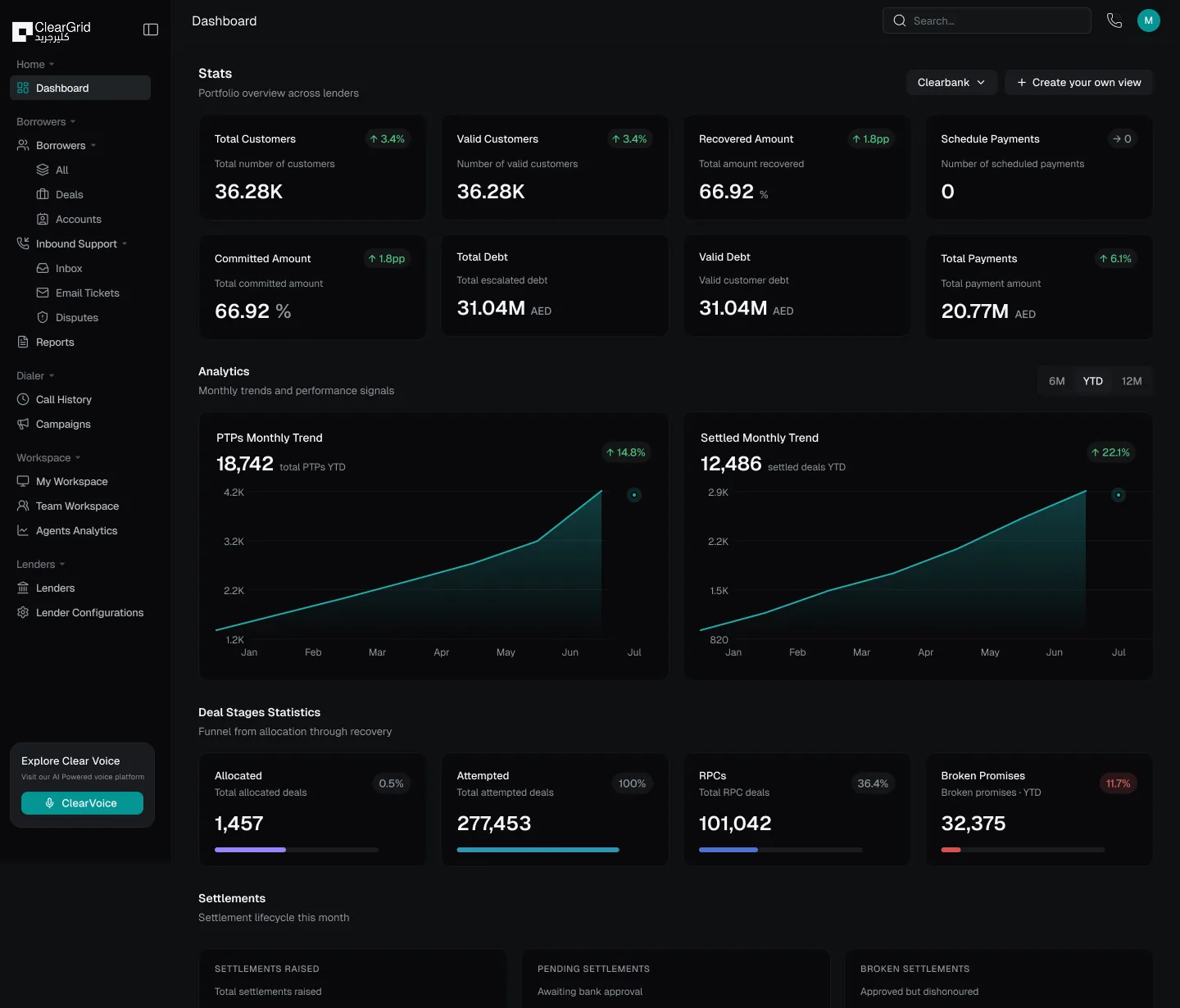
Command dashboard: portfolio stats, settlements and deal-stage statistics per lender Switchable per lender Settlements tracked to the cash landing
01 · Dashboard

Know where the portfolio stands.

Live numbers rather than yesterday’s report. Allocation versus recovery by ageing bucket, and the whole funnel from allocated to resolved.

Explore the module
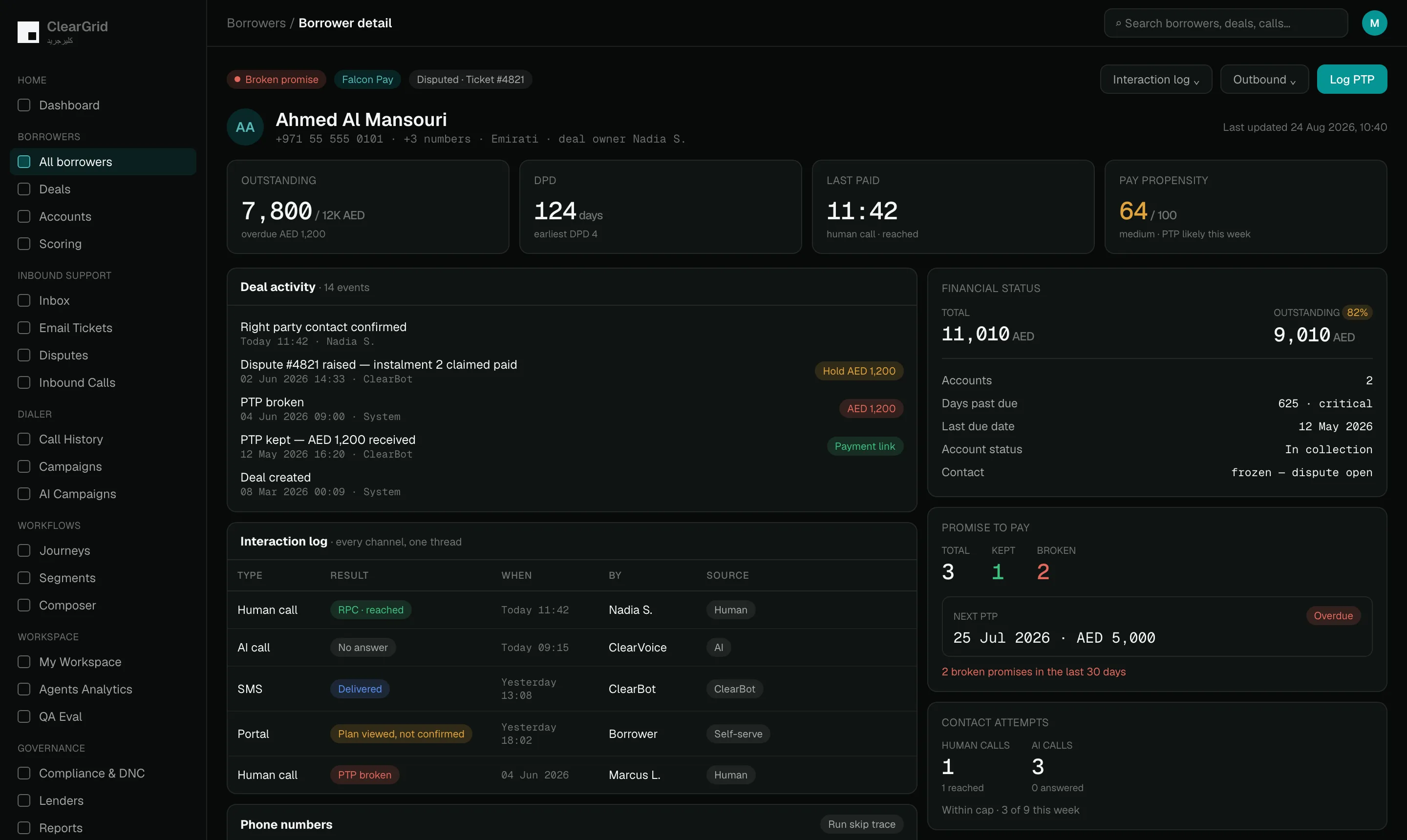
Borrower profile: balance, days past due, pay propensity, accounts held, the deal-activity trail and promise-to-pay history One borrower, every account Full interaction timeline
02 · Borrower record

Every borrower, one complete record.

Contact details, accounts, instalments and the full history, so an agent opens a case already knowing the story.

Explore the module
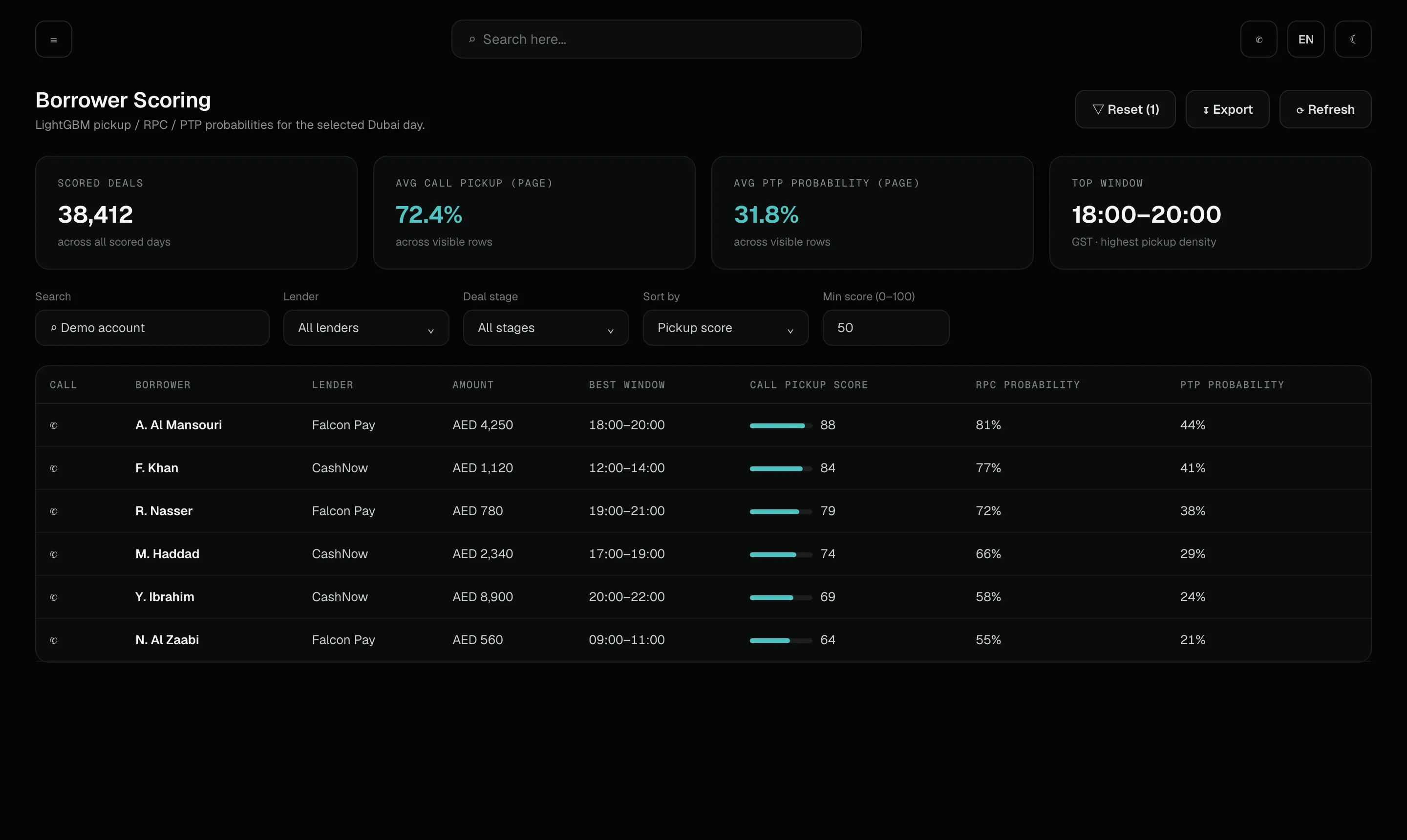
Borrower scoring: pay probability, pickup probability and best contact window per borrower Top window 18:00–20:00 GST Pickup, RPC and PTP per row
03 · Borrower scoring

Work the accounts most likely to pay.

Two scores per borrower, refreshed daily: how likely they are to pay, and how likely a call is to connect. Every score explainable, factor by factor.

Explore the module
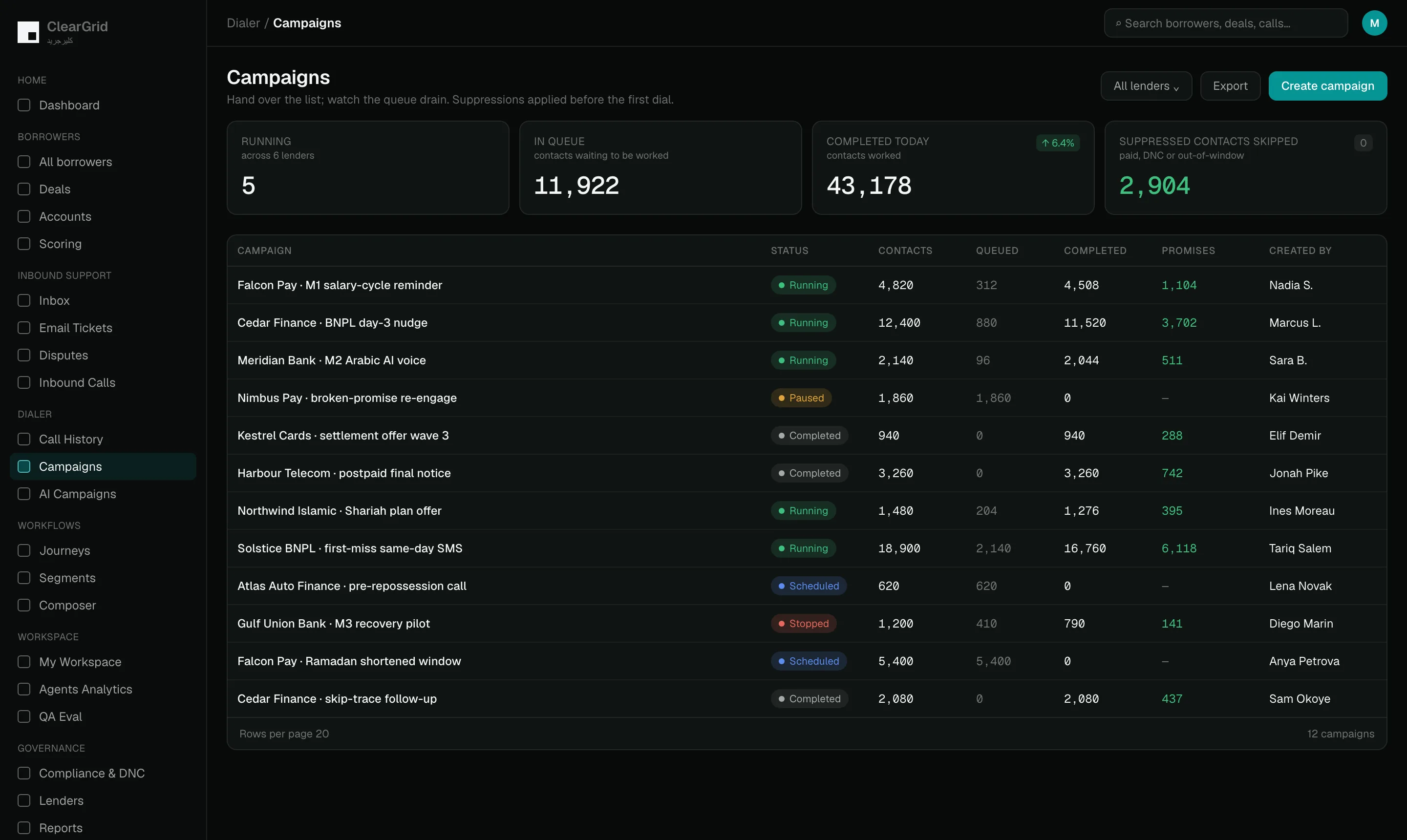
Campaigns: contacts, queued, completed, successful and failed counts per campaign, with live status Pause or stop mid-flight Contacts, queued, completed, failed
04 · Campaigns

Run outreach at portfolio scale.

Every campaign with its contacts, queue and outcomes — pausable mid-flight, and reporting back against the journey that governs it.

Explore the module
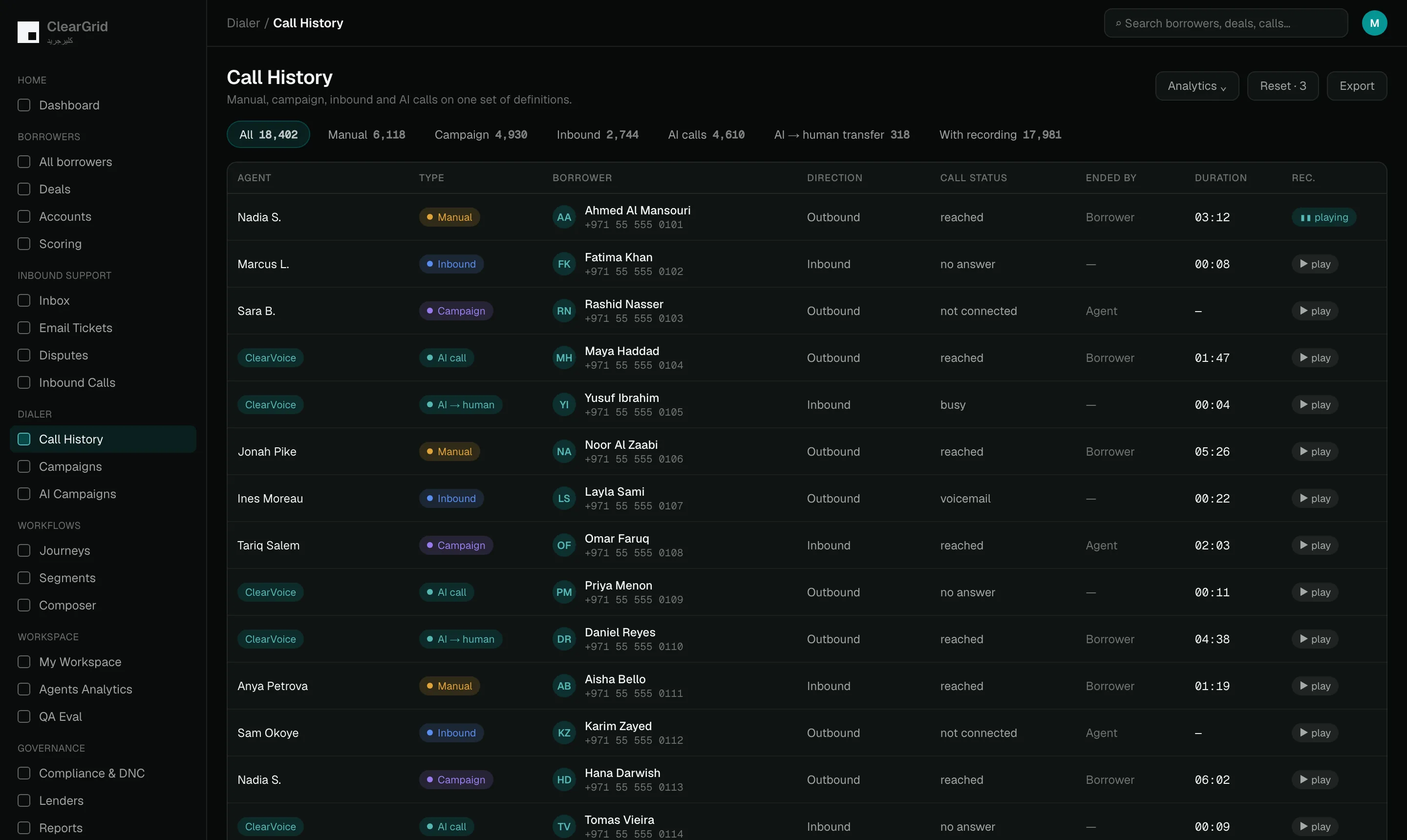
Call History: manual, campaign, inbound, AI and AI-to-human transfer calls with outcome, disposition, duration and audit status AI → human transfer, mid-call Every call audit-logged
05 · AI voice (ClearVoice)

Calls that collect, at any volume.

Agents that verify, negotiate and log every word in Arabic and English — and hand over to a person the moment they should.

Inside ClearVoice
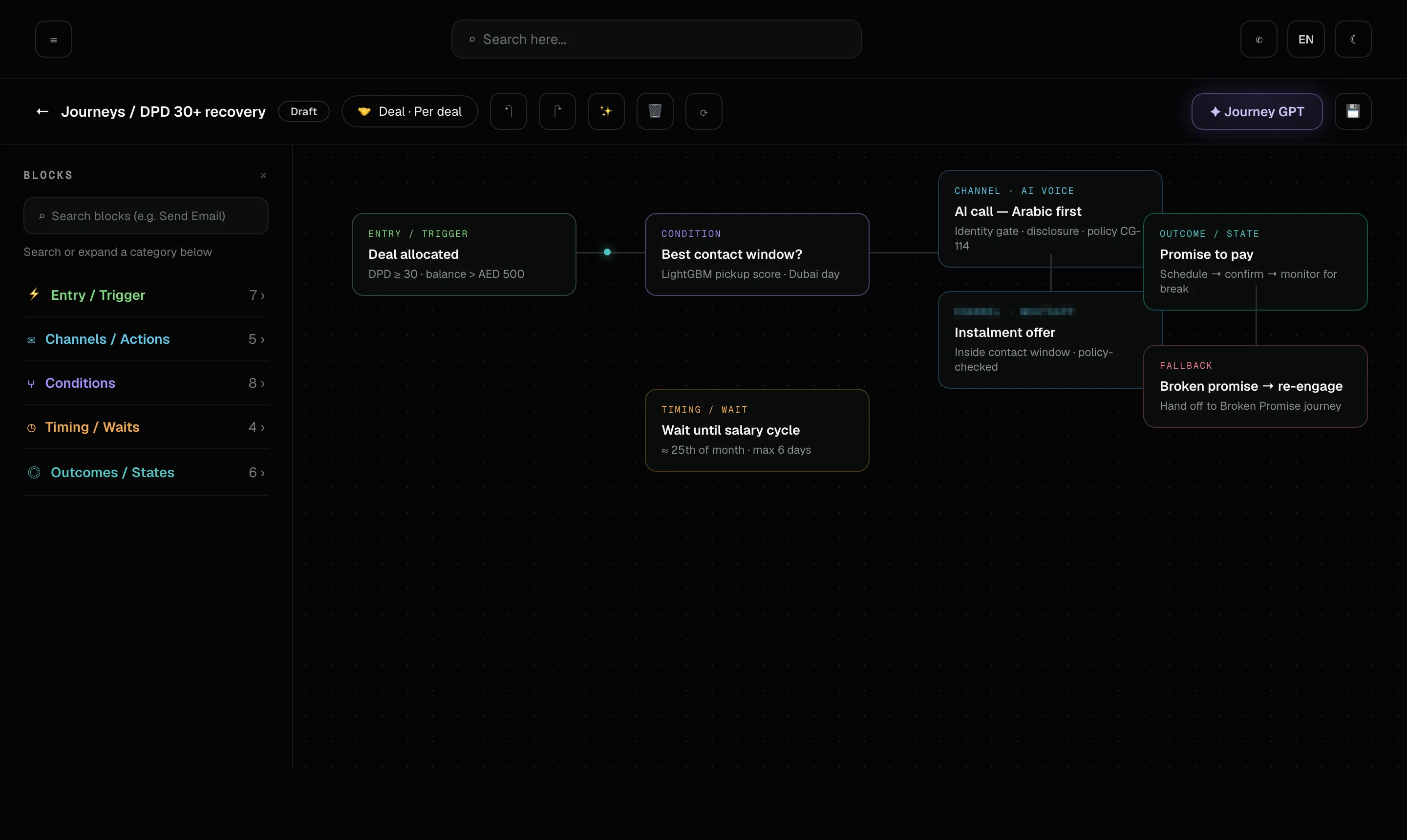
Journey builder: entry triggers, condition branches, AI call steps and governed exits Journey GPT drafts the canvas Wait until the salary cycle Broken promise hands to its own journey
06 · Journeys

Set the strategy once. It runs itself.

Your treatment drawn on a canvas: triggers, waits, branches, messages and AI calls, running for every borrower without an agent starting it.

Explore the module
Agent workspace

Your human team, running on rails.

Your collectors open one screen that already knows what is overdue, what was promised, what broke, and what to say about it.

My Workspace: overdue, due today, upcoming and completed counts, today's schedule with Resume My Day, and the task queue
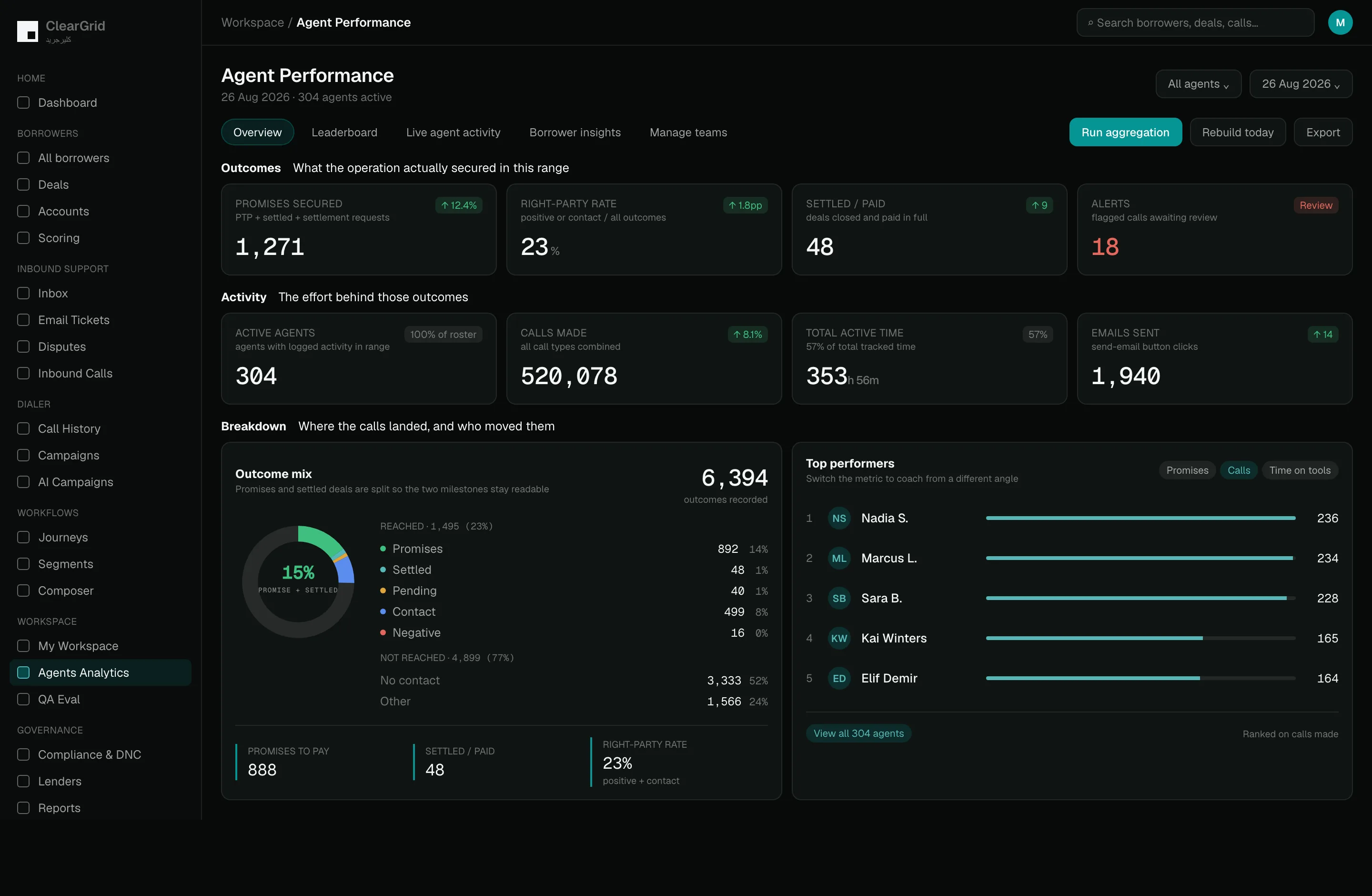
07 · Agent analytics

Manage the floor on evidence.

Productivity, outcomes and effort across every agent and team, so coaching is based on the same numbers everyone can see.

The metrics that decide recovery

Promises secured, right-party rate, calls made and active time, by team and by date range.

Compare like for like

Leaderboards rank on promises, volume or time — because high activity and high conversion are not the same skill.

See where the shift actually goes

Tool-usage and time-spent views show whether effort is landing on the highest-value work.

Agent analytics: promises secured, right-party rate, active versus idle time, the reached and not-reached outcome mix, top performers and per-agent activity

Managing a floor on impressions today? We will run your last full month through this and show you what it says.

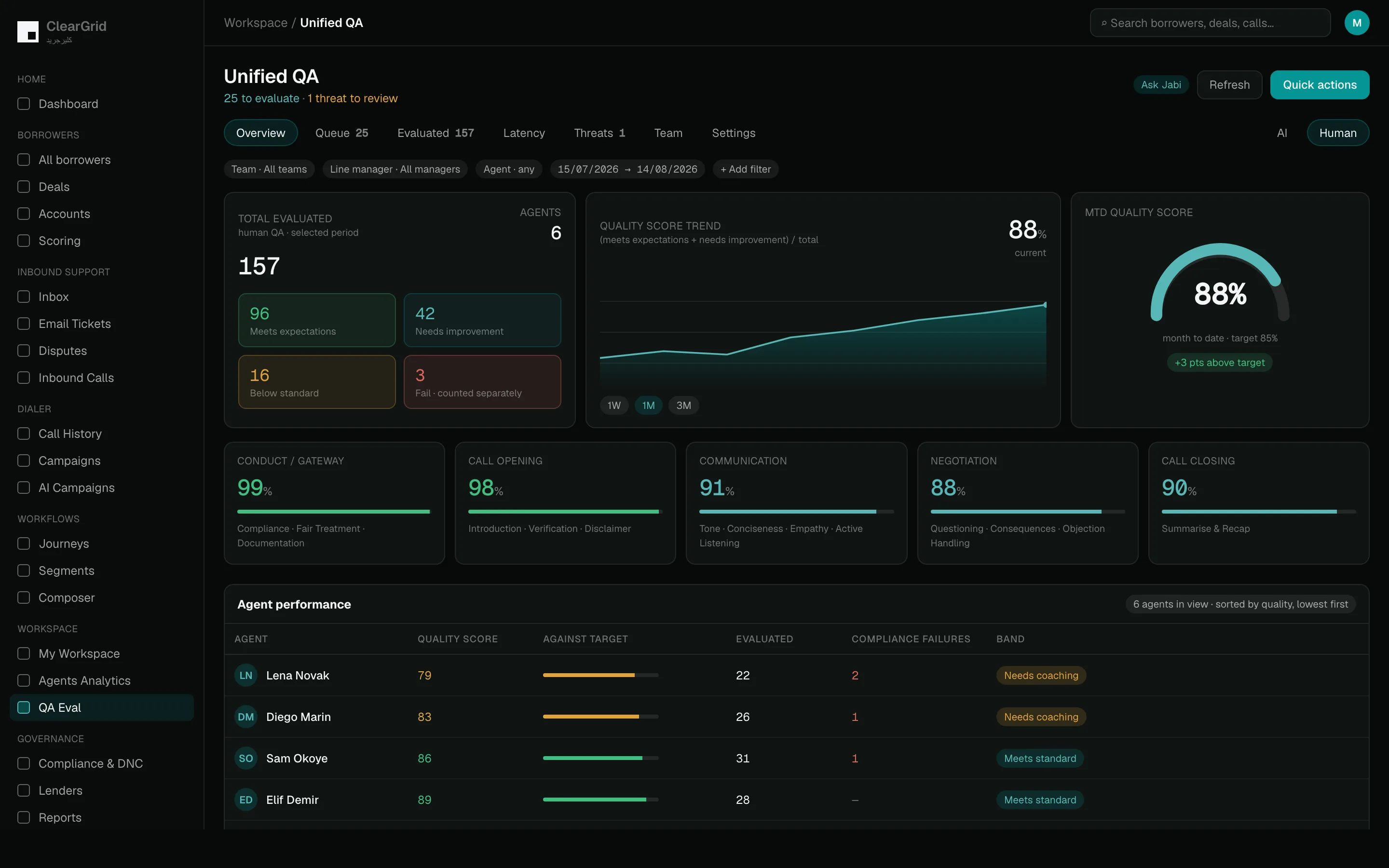
08 · Unified QA

Every call judged by the same standard.

AI calls and human calls scored against one weighted quality model, with a person approving every evaluation.

One model for AI and people

Switch between the two with one toggle and the numbers mean the same thing on both sides.

An AI co-evaluator drafts it, a person approves it

Our AI co-evaluator (Jabi) drafts the scorecard in seconds, every check carrying a confidence level and a quote from the call as evidence.

Legal threats never wait in a queue

Any mention of a lawyer, the police or a complaint is pulled for human review, and the escalation reaches you with a written reason and acknowledgment tracking.

Your policy becomes the scorecard

Your rules are wired into how calls are judged, and every version is fingerprinted — so you can always see which rules judged which call.

Unified QA: quality score against target, 100% call coverage, AI and human scored on one rubric, four performance bands, and failed checks named and counted by category

Every call, scored the same way — AI and human. Bring your own scorecard and we will map it onto this before you commit.

09 · Compliance controls

The rules live in the system, not the induction deck.

Contact governance, duplicate detection and a do-not-contact audit, applied at decision time on every channel — including your agencies’ activity.

Do-not-contact audit

A standing record of who must not be contacted and proof that the rule held, per account and per channel.

Duplicate detection

The same borrower arriving twice under different references is surfaced before you contact them twice.

Contact windows and frequency caps

Set once, enforced by the platform on voice, SMS and email alike.

Offer eligibility

Settlements, restructures and plans offered only where your policy allows, checked per account at decision time.

10 · Multi-lender governance

Built to run many books at once.

For banks with several portfolios, and for agencies running Command across a panel of clients.

Lender register

Every lender, portfolio and product held separately, with the dashboard switchable between one and all.

Per-lender configuration

Each lender’s conduct rules, templates, offers and reporting definitions configured independently.

Agency management

Run third-party agencies from inside Command: performance-based routing, benchmarking on shared definitions, one borrower trail across the panel.

Reports and exports

Payment, SMS, email and call reporting per lender, exportable, on definitions you agree up front.

Getting live

Live in stages, with a gate at every step.

No system replacement and no big-bang cutover. Command connects to your data, mirrors your treatment policy, and proves itself before it touches a live borrower.

01

Connect

Accounts flow in over SFTP or API. Your portfolio structure, buckets and reference IDs are preserved.

02

Configure

Deal stages, message templates, journeys and allocation rules set to your policy, not a default.

03

Validate

Journeys simulated against real data and signed off with your team before anything is sent.

04

Go live & tune

Start on one segment, measure against your existing process, then widen the rollout.

Start with a short proof of value — one segment, a fixed window, measured against your current process. Nothing is replaced; Command runs alongside your core systems.

Is this the right model for you?

You collect, we collect, or both.

First-party collections (Command) is for lenders with an in-house operation that want better tooling. If you would rather hand the portfolio over entirely and have ClearGrid collect as your agency, that is Allocate. If you want your team on part of the book and ours on the rest, that is Hybrid. Same platform underneath in every case.

2–6 wks
typical time to live
+38%
increase in collections
2x
faster resolutions
Trust

Built for compliance-first institutions.

ISO 27001:2022 certified and SOC 2 attested, data held in region, role-based access, and an audit trail your compliance team can reconstruct any account from. Your policy is enforced by the engine, not by training.

See Command with your data on screen.

Thirty minutes, every module, your portfolio. Pilot on a slice, measure against your current benchmark, decide on the numbers.

Book a consultation