Collections has been built around activity, dials, messages, agent tasks. ClearGrid is built around resolution: one intelligence layer that runs every account through a continuous loop.
A campaign runs once and stops. This runs continuously: every outcome changes the account state, and the changed state changes the next decision.
Scroll the diagram sideways to read it →
Share a slice of your delinquent portfolio via secure file transfer or API, balances, DPD, contact details, payment history. Real-time or batch, with automated reconciliation. Most lenders onboard in 2–6 weeks; pilots start with a flat-file extract.
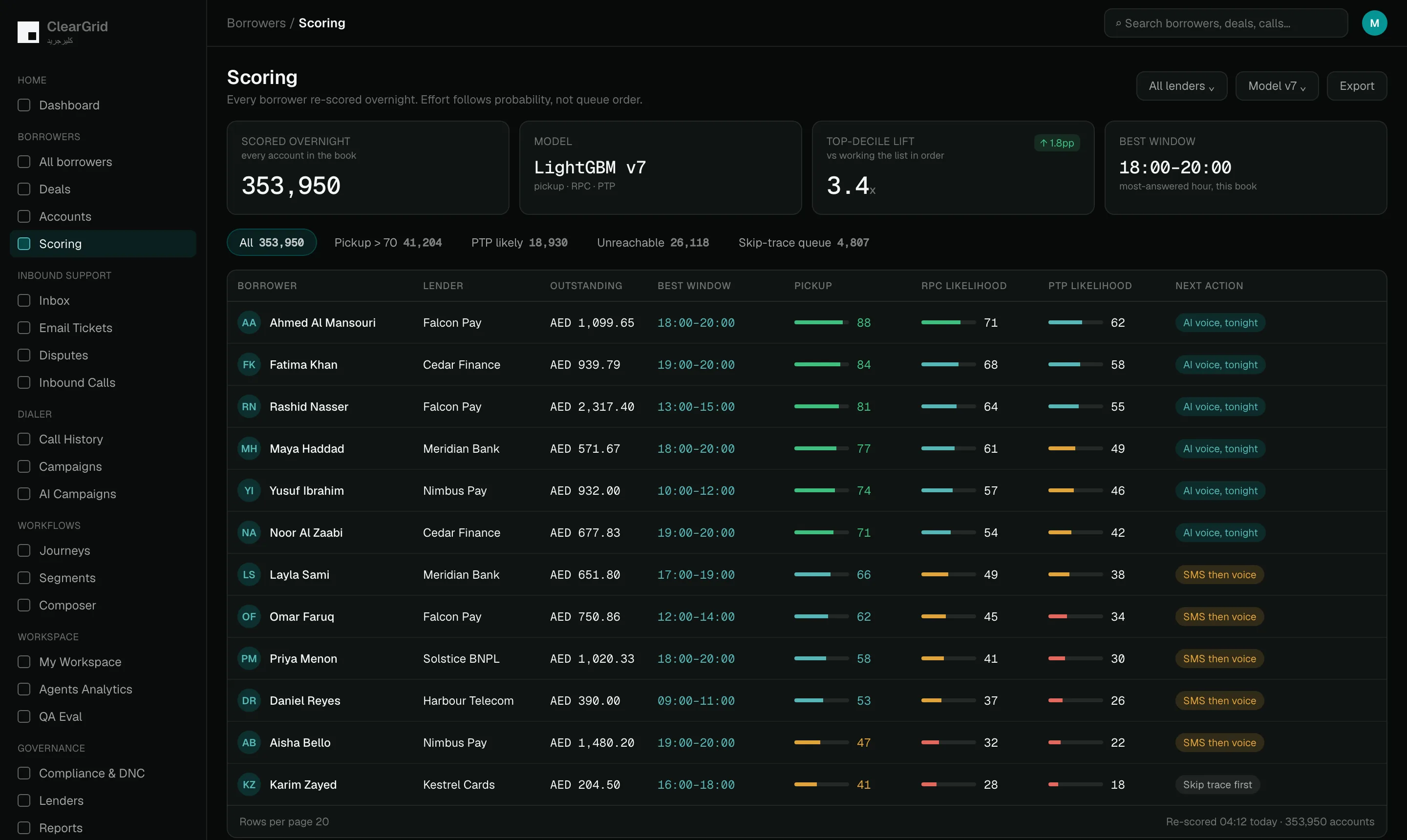
Each account gets one live state: balance, days past due, payment history, promises made and broken, behaviour, offer eligibility, and your policy constraints. Every decision starts here, not from a call list.
The engine picks the next-best action per account: which channel, what time, what message, which offer, whether to escalate or pause. Recalculated as the account changes, a payment lands, a promise breaks, a dispute opens.
Execution across AI voice, SMS, email, the self-service portal, or a human specialist, in Arabic and English, inside contact windows and frequency caps you define.
Payments, promises-to-pay, broken promises, hardship, disputes, settlements, each becomes a tracked state with its own follow-up logic and a complete evidence trail.
Every outcome feeds back into the strategy for that account and the wider portfolio. In live deployments this loop has added 2–7% recovery uplift on its own.
Every channel operates from the same context. Every action follows your policies. That's the difference between an orchestrated resolution system and a stack of disconnected tools, and it's why the audit trail is complete by construction, not by reconciliation.
How the AI decides →